

If a Panamanian birth certificate is to be used abroad, it must be duly issued and authenticated by the Electoral Tribunal of Panama, after which an apostille certificate must be obtained from the Ministry of Foreign Affairs of Panama. The following is a clear and practical guide to the process.
1. Obtain the Birth Certificate
Birth certificates are issued by the Civil Registry Office of the Electoral Tribunal of Panama.
Each birth certificate includes a QR code that allows its authenticity to be verified online. By scanning the QR code, the certificate can be accessed, downloaded, and printed in either black and white or full color.
Please check the issuance date and expiration carefully. Some countries require recently issued birth certificates, for example, certificates issued within the last three (3) to six (6) months.
Birth Certificate (Short Form vs. Long Form)
- Abbreviated or short-form birth certificate: Standard format, sufficient for many administrative procedures.
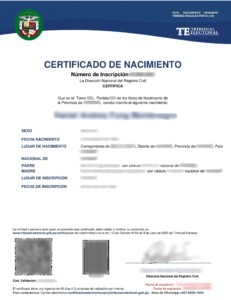
- Full copy or long form birth certificate: Includes additional personal and registry details. Some foreign authorities specifically require this version.
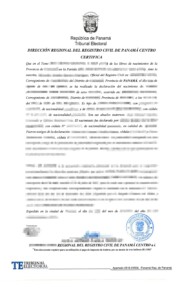

An apostille certificate may be obtained for each version.
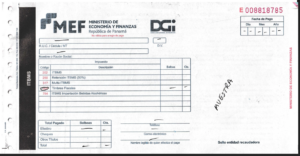
2. Pay the Required Fees
Before requesting an apostille certificate, the applicable fees must be paid.
- Revenue stamp for the birth certificate.
- Apostille fee.

3. Authentication
Before applying for an apostille, the birth certificate must first be authenticated by the Civil Registry.
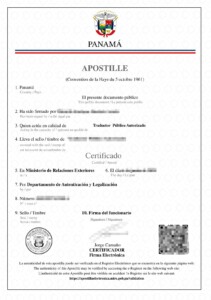
4. Apostille at the Ministry of Foreign Affairs
Once issued and properly authenticated, the apostille certificate must be requested at the Ministry of Foreign Affairs of Panama.
- The apostille confirms the authenticity of the signature and the seal or stamp on the public document.
- This step makes the document legally valid for use in all countries that are members of the Hague Apostille Convention.
5. Use Abroad
After obtaining an apostille certificate, the birth certificate can be used abroad for purposes such as:
- Citizenship or nationality applications
- Immigration or residency procedures
- Marriage registration
- Inheritance or family law matters
6. Translation from Spanish into a Foreign Language
Make sure to contact a qualified Panamanian translator. The translation must cover the entire content of the document, including all text and numbers, descriptive legends, stamps, seals, watermarks, and any other elements appearing on the original document. For this reason, the translation is considered a faithful/exact and complete translation of the original.

Conclusion
Obtaining a birth certificate and, when required, an apostille is an essential step for using private or public documents abroad. It is important to ensure that the certificate is properly issued and authenticated, and that an apostille certificate is obtained, so that it will be accepted in the receiving country. Verifying issuance dates, validity periods, and document versions in advance can help avoid delays and ensure the document is accepted for its intended legal, immigration, or administrative purpose.
If you need assistance with requesting a birth certificate, obtaining an apostille certificate, or arranging a translation from Spanish into a foreign language, please contact us today.
Edgardo Espinosa, Esq.
Attorney-at-Law and Certified Translator
The Century Tower, 4th Floor, Suite 401
Ricardo J. Alfaro Avenue
Panama City, Panama
Tel.: +507 6290-3468
Email: [email protected]